


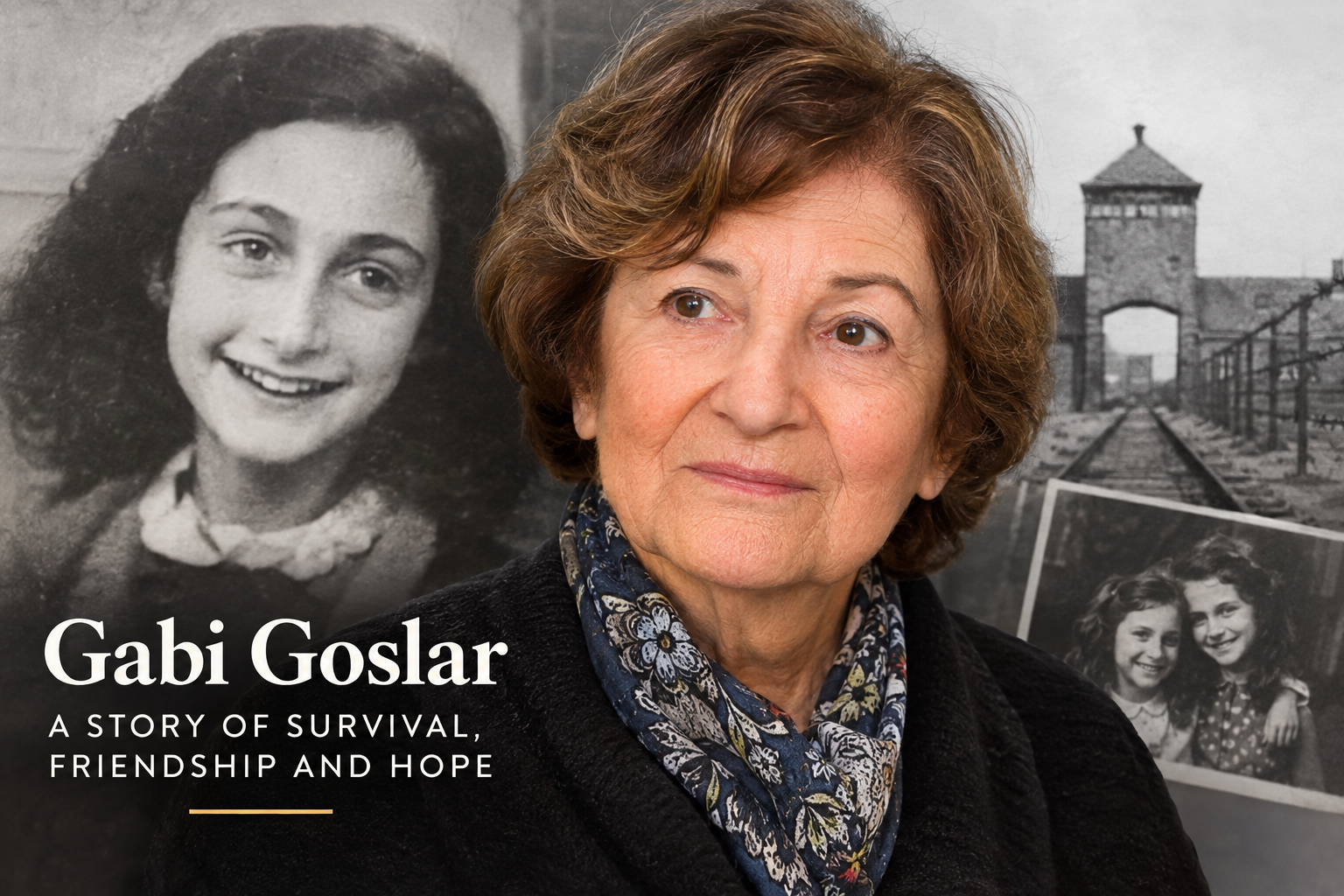
Gabi Goslar is a name closely connected with one of the most painful chapters of twentieth-century European history. Her story is remembered through her connection with Anne Frank and the world surrounding the Frank family during the Nazi occupation of the Netherlands.
Unlike many historical figures, Goslar did not become known because she sought public attention. Her importance comes from what she witnessed and remembered. She belonged to the same generation of Jewish children whose ordinary childhoods were shattered by persecution and war.
Gabi was born into a Jewish family in Germany. Her childhood later moved to the Netherlands, where her family hoped to find safety. That hope was eventually destroyed by the Nazi occupation.
Her friendship with Anne Frank gives her story a deeply personal dimension. The two girls knew each other before the war changed their lives. Their experiences later became part of the historical record surrounding Anne Frank’s life and legacy. [Insert Anne Frank House Reference Link Here]
Gabi Goslar at a Glance
| Detail | Information |
|---|---|
| Full Name | Gabi Goslar |
| Known As | Gabi Goslar |
| Birthplace | Germany |
| Nationality | German-Jewish / Dutch historical context |
| Known For | Friendship with Anne Frank and Holocaust testimony |
| Historical Significance | Survivor and witness connected to Anne Frank’s early life |
| Major Recognition | Holocaust testimony and historical accounts |
Childhood Before the War Changed Everything
Gabi Goslar was born into a Jewish family in Germany during a period of growing political instability.
Her early childhood was not initially defined by the horrors that would later surround her. Like many children, she experienced school, friendships, family life, and the ordinary routines of growing up.
That normality did not last.
Adolf Hitler’s rise to power in 1933 brought increasingly harsh restrictions against Jewish people. Laws removed basic rights and separated Jewish citizens from wider German society. Families began facing discrimination in schools, employment, and public life. [Insert United States Holocaust Memorial Museum Reference Link Here]
Gabi’s family eventually left Germany. They moved to the Netherlands, hoping that the country would provide greater security.
Amsterdam became part of Gabi’s childhood.
There, she attended school and developed friendships. One of those friendships became historically significant.
She met Anne Frank.
The two girls were close in age. They attended the same school environment and knew each other before Anne’s family went into hiding.
At that stage, neither girl could have understood how dramatically their lives would change.
Anne was known as lively and expressive. She dreamed about writing and becoming a published author. Gabi’s life followed a very different path. Her later memories would become valuable because they preserved details about Anne before hiding became part of her story.
The German occupation of the Netherlands transformed daily life.
Jewish families faced registration, restrictions, forced separation, and deportation. Children were pulled away from normal education. Families lived under constant fear.
For Gabi, childhood ended under circumstances no child should experience.
From Friendship to a Story of Survival
Gabi Goslar’s connection with Anne Frank became especially significant after the Frank family disappeared from public life.
In 1942, Anne and her family went into hiding in Amsterdam. Their hiding place became famous after Anne’s diary was published following the war.
Gabi’s own family experienced persecution directly.
Eventually, she and her family were deported. Gabi survived the Holocaust, although members of her family did not. Her memories later helped historians and the public understand the human reality behind Holocaust statistics. [Insert Holocaust Museum Reference Link Here]
One of the most striking parts of Gabi’s story concerns her later experiences during the war.
She was imprisoned in the Bergen-Belsen concentration camp. Anne Frank was also eventually transported to Bergen-Belsen.
Their paths crossed again under unimaginable conditions.
According to historical accounts, Gabi discovered that Anne was being held in another section of the camp. The girls were separated by fences and darkness, yet they managed to communicate.
Gabi reportedly attempted to help Anne by throwing food over a fence.
The moment carries enormous historical weight.
Two childhood friends had met again after years of persecution. Neither was living the childhood they once knew. Their world had been reduced to survival.
Anne died at Bergen-Belsen in early 1945.
Gabi survived.
The war eventually ended, but survival did not erase what she had experienced.
Her memories became part of the wider historical record.
What Gabi Goslar Remembered About Anne Frank
Gabi’s recollections are valuable because they show Anne before the diary made her famous.
Anne Frank is often remembered through her writing. Gabi’s memories offer another perspective.
She knew Anne as a school friend.
That distinction matters.
The diary presents Anne’s inner thoughts, ambitions, fears, and frustrations. Gabi’s memories help place that writer within a real childhood environment.
The girls had ordinary conversations. They attended school. They formed friendships. They lived in a city that would later become central to Anne’s story.
This human detail gives greater meaning to Anne’s later writings.
Gabi also became one of the people who could speak about the final period of Anne’s life. Her testimony has been discussed in historical accounts of Bergen-Belsen and Anne’s final months. [Insert Anne Frank House Reference Link Here]
Her memories do not replace Anne’s diary.
Instead, they add another layer.
They remind readers that Anne was a child before she became a historical symbol.
Life After Liberation
Surviving the Holocaust created a difficult question for people like Gabi: how should someone rebuild a life after such destruction?
Gabi eventually built a life beyond the camps.
Her survival itself became part of a larger story of remembrance.
For Holocaust survivors, telling personal memories became one way to preserve historical truth. Gabi’s experiences have therefore mattered beyond her own biography.
Her story has been included in discussions, interviews, documentaries, and historical accounts concerning Anne Frank and the Holocaust. [Insert Major News/Archive Reference Link Here]
Unlike celebrities whose public identities grow through constant exposure, Gabi’s historical importance comes from testimony.
She represents a generation whose childhood was interrupted by genocide.
Her story also demonstrates how individual memories can preserve details that statistics cannot.
Millions of Jewish people were murdered during the Holocaust. Each victim had a family, a childhood, friendships, ambitions, and personal memories.
Gabi’s story makes that reality more personal.
Why Gabi Goslar’s Story Still Matters
Gabi Goslar’s historical significance is closely connected with memory.
She survived an event that killed millions. She also knew Anne Frank before Anne became one of the world’s best-known diarists.
That connection gives historians another window into Anne’s early years.
However, Gabi’s story deserves attention on its own.
She was more than Anne Frank’s friend.
She was a Jewish child who experienced Nazi persecution. She was a concentration-camp survivor. She became a witness to history.
Her experiences also highlight the importance of survivor testimony.
Written documents provide one kind of evidence. Personal memories provide another. Together, they help reconstruct the human experience of the Holocaust.
Gabi’s life therefore belongs to a broader history of survival and remembrance.
Her story continues to be relevant because younger generations still encounter the Holocaust mainly through books, museums, films, and education.
Personal accounts make that history more tangible.
They show what persecution looked like at the level of everyday life.
Lessons From Gabi Goslar’s Life
- Remember history: Personal stories preserve human details.
- Value testimony: Survivors provide irreplaceable perspectives.
- Protect childhood: Children should never inherit political hatred.
- Preserve memory: Historical truth depends on remembrance.
Disclaimer: This biography is compiled from publicly available historical records, survivor accounts, interviews, archival materials, and reputable news or educational sources. It is intended solely for educational and informational purposes. Some personal details may vary between historical accounts and should be verified against primary archival sources.
Read more:FintechZoom.io: Complete Guide, Features, History & Facts